Showing posts with label Federal Reserve. Show all posts

Tuesday, May 7, 2013

11 Reasons Why The Federal Reserve Should Be Abolished

The Federal ReserveIf the American people truly understood how the Federal Reserve system works and what it has done to us, they would be screaming for it to be abolished immediately.  It is a system that was designed by international bankers for the benefit of international bankers, and it is systematically impoverishing the American people.  The Federal Reserve system is the primary reason why our currency has declined in value by well over 95 percent and our national debt has gotten more than 5000 times larger over the past 100 years.  The Fed creates our "booms" and our "busts", and they have done an absolutely miserable job of managing our economy.  But why do we need a bunch of unelected private bankers to manage our economy and print our money for us in the first place?  Wouldn't our economy function much more efficiently if we allowed the free market to set interest rates?  And according to Article I, Section 8 of the U.S. Constitution, the U.S. Congress is the one that is supposed to have the authority to "coin Money, regulate the Value thereof, and of foreign Coin, and fix the Standard of Weights and Measures".  So why is the Federal Reserve doing it?  Sadly, this is the way it works all over the globe today.  In fact, all 187 nations that belong to the IMF have a central bank.  But the truth is that there are much better alternatives.  We just need to get people educated.

The following are 11 reasons why the Federal Reserve should be abolished...

#1 The Greatest Period Of Economic Growth In The History Of The United States Happened When There Was No Central Bank

Did you know that the greatest period of economic growth in U.S. history was between the Civil War and 1913?  And guess what?  That was a period when there was no central bank in the United States at all.  The following is from Wikipedia...
The Gilded Age saw the greatest period of economic growth in American history. After the short-lived panic of 1873, the economy recovered with the advent of hard money policies and industrialization. From 1869 to 1879, the US economy grew at a rate of 6.8% for real GDP and 4.5% for real GDP per capita, despite the panic of 1873.  The economy repeated this period of growth in the 1880s, in which the wealth of the nation grew at an annual rate of 3.8%, while the GDP was also doubled.
So if our greatest period of economic prosperity was during a time when there was no Federal Reserve, then why shouldn't we try such a system again?

#2 The Federal Reserve Is Systematically Destroying The Value Of The U.S. Dollar

The United States never had a persistent, ongoing problem with inflation until the Federal Reserve was created in 1913.

If you do not believe this, just check out the inflation chart in this article.

The Federal Reserve systematically penalizes those that try to save their money.  Inflation is a tax, and the value of each one of our dollars goes down a little bit more every single day.

But over time, it really adds up.  In fact, the value of the U.S. dollar has fallen by 83 percent since 1970.


Anyone that goes to the grocery store on a regular basis knows how painful inflation can be.  The following is a list that shows how prices for many of the things that we buy on a regular basis absolutely skyrocketed between 2002 and 2012...

Eggs: 73%
Coffee: 90%
Peanut Butter: 40%
Milk: 26%
A Loaf Of White Bread: 39%
Spaghetti And Macaroni: 44%
Orange Juice: 46%
Red Delicious Apples: 43%
Beer: 25%
Wine: 60%
Electricity: 42%
Margarine: 143%
Tomatoes: 22%
Turkey: 56%
Ground Beef: 61%
Chocolate Chip Cookies: 39%
Gasoline: 158%

Even the price of water has absolutely soared in recent years.  According to USA Today, water bills have actually tripled over the past 12 years in some areas of the country.

So how can the Federal Reserve get away with claiming that we are in a "low inflation" environment?
Well, what Ben Bernanke never tells you is that the way that the government calculates inflation has changed more than 20 times since 1978.

The truth is that the real rate of inflation is somewhere between five and ten percent right now, but you will never hear about this on the mainstream news.

#3 The Federal Reserve Is A Perpetual Debt Machine

The Federal Reserve system was designed to be a trap.  The intent of the bankers was to trap the U.S. government in an endless debt spiral from which it could never possibly escape.

But most Americans don't understand this.  In fact, most Americans don't even understand where money comes from.

If you don't believe this, just go out on the street and ask regular people where money comes from.  The responses will be something like this...

"Duh - I don't know.  I've got to get home to watch American Idol."

This is why it is so important to get people educated.  I think that most Americans would be horrified to learn that the creation of more money in our system also involves the creation of more debt.
The following is a summary of money creation that comes from one of my previous articles...
When the U.S. government decides that it wants to spend another billion dollars that it does not have, it does not print up a billion dollars.
Rather, the U.S. government creates a bunch of U.S. Treasury bonds (debt) and takes them over to the Federal Reserve.
The Federal Reserve creates a billion dollars out of thin air and exchanges them for the U.S. Treasury bonds.
So what does the Federal Reserve do with those Treasury bonds?  I went on to explain what happens...
The U.S. Treasury bonds that the Federal Reserve receives in exchange for the money it has created out of nothing are auctioned off through the Federal Reserve system.
But wait.
There is a problem.
Because the U.S. government must pay interest on the Treasury bonds, the amount of debt that has been created by this transaction is greater than the amount of money that has been created.
So where will the U.S. government get the money to pay that debt?
Well, the theory is that we can get money to circulate through the economy really, really fast and tax it at a high enough rate that the government will be able to collect enough taxes to pay the debt.
But that never actually happens, does it?
And the creators of the Federal Reserve understood this as well.  They understood that the U.S. government would not have enough money to both run the government and service the national debt.  They knew that the U.S. government would have to keep borrowing even more money in an attempt to keep up with the game.
Men like Thomas Edison and Henry Ford could not understand why we would adopt such a foolish system.  For example, Thomas Edison was once quoted in the New York Times as saying the following...
That is to say, under the old way any time we wish to add to the national wealth we are compelled to add to the national debt.
Now, that is what Henry Ford wants to prevent. He thinks it is stupid, and so do I, that for the loan of $30,000,000 of their own money the people of the United States should be compelled to pay $66,000,000 — that is what it amounts to, with interest. People who will not turn a shovelful of dirt nor contribute a pound of material will collect more money from the United States than will the people who supply the material and do the work. That is the terrible thing about interest. In all our great bond issues the interest is always greater than the principal. All of the great public works cost more than twice the actual cost, on that account. Under the present system of doing business we simply add 120 to 150 per cent, to the stated cost.
But here is the point: If our nation can issue a dollar bond, it can issue a dollar bill. The element that makes the bond good makes the bill good.
Unfortunately, today most Americans don't even understand how the system works.  They just assume that we have the best system in the entire world.

Sadly, the reality is that the system is working just as the international bankers that designed it had hoped.  The United States has the largest national debt in the history of the world, and we are stealing more than 100 million dollars from our children and our grandchildren every single hour of every single day in a desperate attempt to keep the debt spiral going.

#4 The Federal Reserve Is A Centrally-Planned Financial System That Is The Antithesis Of What A Free Market System Should Be
Why do we need someone to centrally-plan our financial system?

Isn't that the kind of thing they do in communist China?

Why do we need someone to tell us what interest rates are going to be?

Why do we need someone to determine what "the target rate of inflation" should be?

If we actually had a free market system, the free market would be the one "managing" our economy.
But instead, we have become so accustomed to central planning that any alternatives seem to be absolutely unthinkable.

For example, CNBC cannot possibly imagine a world where the Fed (or some similar institution) was not running things...
But suppose the law were taken off the books? The Fed's job—in simple terms—is to manage the nation's money supply and achieve the sometimes-conflicting tasks of full employment, stable prices while fighting inflation or deflation.

How would the U.S. economy then function? Something has to take its place, right?
Global markets would also need some sort of economic direction from the U.S. The Fed manages the dollar — and as the world's leading currency, a void left by a Fed-less America could throw those markets into chaos with uncertainty about who's managing U.S. interest rates and the American economy.
I've got an idea - let's let the free market "manage" U.S. interest rates and the American economy.
I know, it's a crazy idea, but I have a sneaking suspicion that it just might work beautifully

#5 The Federal Reserve Creates Bubbles And Busts

Do you remember the Dotcom bubble?

Or what about the housing bubble?

By dramatically distorting interest rates and financial behavior, the Federal Reserve creates economic bubbles and the corresponding economic busts.

And guess what?

Now it is happening again.

When will the American people decide that they have had enough?

If you can believe it, there have been 10 different economic recessions since 1950.  And of course the Federal Reserve even admits that it helped create the Great Depression of the 1930s.

Perhaps it is time to try something different.

#6 The Federal Reserve Is Privately Owned
It has been said that the Federal Reserve is about as "federal" as Federal Express is.
Most Americans still believe that the Federal Reserve is a "federal agency", but that is simply not true.  The following comes from factcheck.org...
The stockholders in the 12 regional Federal Reserve Banks are the privately owned banks that fall under the Federal Reserve System. These include all national banks (chartered by the federal government) and those state-chartered banks that wish to join and meet certain requirements. About 38 percent of the nation’s more than 8,000 banks are members of the system, and thus own the Fed banks.
And even the Federal Reserve itself has argued that it is "not an agency" of the federal government in court.

So why is there still so much confusion about this?

We should not be allowing a private entity that is owned and dominated by the banks to make decisions that dramatically affect the daily lives of all the rest of us.

#7 The Federal Reserve Greatly Favors The "Too Big To Fail" Banks
Since the Federal Reserve is owned by the banks, should we be surprised that it serves the interests of the banks?

In particular, the Fed has been extremely good to the "too big to fail" banks.

Over the past several decades, those banks have grown tremendously in both size and power.

Back in 1970, the five largest U.S. banks held 17 percent of all U.S. banking industry assets.

Today, the five largest U.S. banks hold 52 percent of all U.S. banking industry assets.

#8 The Federal Reserve Gives Secret Bailouts To Their Friends

The Federal Reserve is the only institution in America that can print money out of thin air and loan it to their friends any time they want to.

For example, did you know that the Federal Reserve made 16 trillion dollars in secret loans to their friends during the last financial crisis?

The following list is taken directly from page 131 of a GAO audit report, and it shows which banks received secret loans from the Fed...

Citigroup - $2.513 trillion
Morgan Stanley - $2.041 trillion
Merrill Lynch - $1.949 trillion
Bank of America - $1.344 trillion
Barclays PLC - $868 billion
Bear Sterns - $853 billion
Goldman Sachs - $814 billion
Royal Bank of Scotland - $541 billion
JP Morgan Chase - $391 billion
Deutsche Bank - $354 billion
UBS - $287 billion
Credit Suisse - $262 billion
Lehman Brothers - $183 billion
Bank of Scotland - $181 billion
BNP Paribas - $175 billion
Wells Fargo - $159 billion
Dexia - $159 billion
Wachovia - $142 billion
Dresdner Bank - $135 billion
Societe Generale - $124 billion
"All Other Borrowers" - $2.639 trillion

If you will notice, a number of the banks listed above are foreign banks.
Why is the Fed allowed to print money out of thin air and lend it to foreign banks?

#9 The Federal Reserve Is Paying Banks Not To Lend Money
Did you know that the Federal Reserve is actually paying U.S. banks not to lend money?

That doesn't make sense.  Our economy is based on credit, and small businesses desperately need loans in order to operate.

But the Fed has decided to pay banks not to risk their money.  Section 128 of the Emergency Economic Stabilization Act of 2008 allows the Federal Reserve to pay interest on "excess reserves" that U.S. banks park at the Fed.

So the big banks can just send their cash to the Fed and watch the money come rolling in risk-free.
As the chart below demonstrates, the banks have taken great advantage of this tremendous deal...
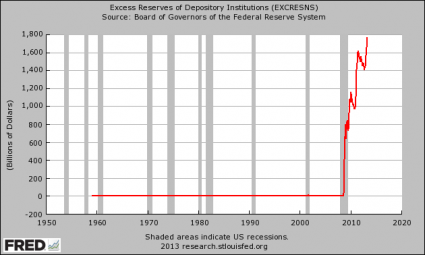
Excess Reserves Parked At The Federal Reserve


#10 The Federal Reserve Has An Astounding Track Record Of Failure

Over the past ten years, the Federal Reserve has been an abysmal failure when it comes to running the economy.

But despite a track record of failure that would make the Chicago Cubs look like a roaring success, Barack Obama actually decided to nominate Ben Bernanke for a second term as the Chairman of the Federal Reserve.

What a mistake.

Just check out some of the things that Bernanke said prior to the last financial crisis.  The following is an extended excerpt from an article that I published previously...
*****
In 2005, Bernanke said that we shouldn't worry because housing prices had never declined on a nationwide basis before and he said that he believed that the U.S. would continue to experience close to "full employment"....
"We’ve never had a decline in house prices on a nationwide basis. So, what I think what is more likely is that house prices will slow, maybe stabilize, might slow consumption spending a bit. I don’t think it’s gonna drive the economy too far from its full employment path, though."
In 2005, Bernanke also said that he believed that derivatives were perfectly safe and posed no danger to financial markets....
"With respect to their safety, derivatives, for the most part, are traded among very sophisticated financial institutions and individuals who have considerable incentive to understand them and to use them properly."
In 2006, Bernanke said that housing prices would probably keep rising....
"Housing markets are cooling a bit. Our expectation is that the decline in activity or the slowing in activity will be moderate, that house prices will probably continue to rise."
In 2007, Bernanke insisted that there was not a problem with subprime mortgages....
"At this juncture, however, the impact on the broader economy and financial markets of the problems in the subprime market seems likely to be contained. In particular, mortgages to prime borrowers and fixed-rate mortgages to all classes of borrowers continue to perform well, with low rates of delinquency."
In 2008, Bernanke said that a recession was not coming....
"The Federal Reserve is not currently forecasting a recession."
A few months before Fannie Mae and Freddie Mac collapsed, Bernanke insisted that they were totally secure....
"The GSEs are adequately capitalized. They are in no danger of failing."
*****

There are many, many more examples that could be listed, but hopefully you get the point.
And now it is happening again.  Bernanke is telling the American people that everything is going to be just fine and that no major problems are ahead.

Do you believe him this time?

#11 The Federal Reserve Is Unaccountable To The American People

What is the most important political issue to most Americans?

Survey after survey has shown that the American people care about the economy more than anything else.

So why do we allow an unelected, unaccountable entity that is privately-owned to make our economic decisions for us?

The Federal Reserve has become so powerful that it has been called "the fourth branch of government".  Every four years, presidential candidates argue about who will be best at managing the economy, but the truth is that it is the Fed that manages our economy.

We are told that the "independence" of the Federal Reserve is absolutely critical, but don't the American people deserve to have a say in the running of the economy?

Our system is broken.  It is a system that will continue to create more bubbles and more debt until the entire thing finally collapses for good.

Thomas Jefferson once stated that if he could add just one more amendment to the U.S. Constitution it would be a ban on all government borrowing....
I wish it were possible to obtain a single amendment to our Constitution. I would be willing to depend on that alone for the reduction of the administration of our government to the genuine principles of its Constitution; I mean an additional article, taking from the federal government the power of borrowing.
But instead of banning government borrowing, we have allowed ourselves to become enslaved to a system where government borrowing actually creates our money.

We do not need to have a central bank.  There are much better alternatives.  We just need to get people educated.

Please share this article with as many people as you possibly can.  These are things that every American should know about the Fed, and we need to educate the American people about the Federal Reserve while there is still time.
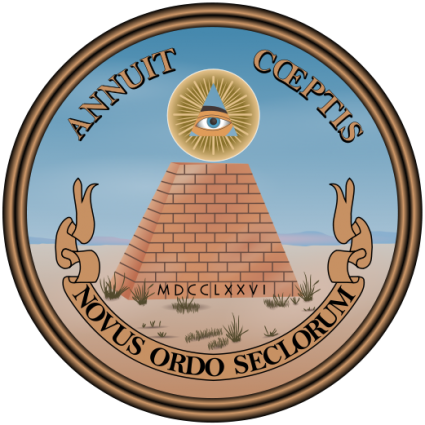
The Great Seal Of The United States - A Symbol Of Your Enslavement - Photo by Ipankonin

Source:

http://theeconomiccollapseblog.com/archives/11-reasons-why-the-federal-reserve-should-be-abolished

Friday, April 26, 2013

Warnings from Former Presidents About Who Really Runs the Show

Verified Warnings From Former U.S. Presidents About the “Invisible Government” Running the U.S. With “No Allegiance To the People”


“Those who do not learn from history are doomed to repeat it.”   ~ George Santayana


Past presidents of the United States and other high profile political leaders have repeatedly issued warnings over the last 214 years that the U.S. government is under the control of an “invisible government owing no allegiance and acknowledging no responsibility to the people.”

According to half-dozen of our former presidents, one vice-president,  and a myriad of other high profile political leaders, an invisible government that is “incredibly evil in intent” has been in control of the U.S. government“ever since the days of Andrew Jackson” (since at least 1836).  They “virtually run the United States government for their own selfish purposes. They practically control both parties… It operates under cover of a self-created screen [and] seizes our executive officers, legislative bodies, schools, courts, newspapers and every agency created for the public protection.”

As a result, “we have come to be one of the worst ruled, one of the most completely controlled and dominated, governments in the civilized world—no longer a government by free opinion, no longer a government by conviction and the vote of the majority, but a government by the opinion and the duress of small groups of dominant men.”

The sources for the above quotes (and more) are listed below. All of the quotes listed in this article have been verified as authentic and have associated links to the source materials.  Also included below are statements made by David Rockefeller, Sr, former director of the Council on Foreign Relations (CFR), and Federal Reserve Chairman’s Alan Greenspan and Ben Bernanke that appear to confirm some of the warnings.

Warnings About the Invisible Government Running the U.S.

The warnings listed below, which appear in chronological order, began with our first president – George Washington.  The last president to speak out was JFK, who was assassinated. Read what they and other political leaders have said about the invisible government. 

George Washington wrote that the Illuminati want to separate the People from their Government.


“It was not my intention to doubt that, the Doctrines of the Illuminati, and principles of Jacobinism had not spread in the United States. On the contrary, no one is more truly satisfied of this fact than I am. The idea that I meant to convey, was, that I did not believe that the Lodges of Free Masons in this Country had, as Societies, endeavoured to propagate the diabolical tenets of the first, or pernicious principles of the latter (if they are susceptible of separation).That Individuals of them may… actually had a separation [sic] of the People from their Government in view, is too evident to be questioned.” – George Washington,  1st President of the United States (1789–1797), from a letter that Washington wrote on October 24, 1798, which can be found in the Library of Congress.  For an analysis of Washington’s warning, see the article “Library of Congress: George Washington Warns of Illuminati”


“I sincerely believe, with you, that banking establishments are more dangerous than standing armies.” —Thomas Jefferson, 3rd President of the United States (1801–1809) and principal author of the United States Declaration of Independence (1776), in a letter written to John Taylor on May 28, 1816
“A power has risen up in the government greater than the people themselves, consisting of many and various powerful interests, combined in one mass, and held together by the cohesive power of the vast surplus in banks.” – John C. Calhoun, Vice President (1825-1832) and U.S. Senator, from a speech given on May 27, 1836
Note that it appears that Washington’s and Jefferson’s concerns regarding bankers and separation of the people from the government was realized by 1836.  This fact was confirmed in a letter written by FDR in 1933 (see below) in which he wrote that “a financial element in the large centers has owned the government ever since the days of Andrew Jackson.”  Jackson was the seventh president of the United States (1829-1937).  Calhoun served as Jackson’s vice-president from 1829-1932.

“Behind the ostensible government sits enthroned an invisible government owing no allegiance and acknowledging no responsibility to the people.  To destroy this invisible government, to befoul the unholy alliance between corrupt business and corrupt politics is the first task of the statesmanship of the day.”— Theodore Roosevelt, 26th President of the United States, Theodore Roosevelt, An Autobiography, 1913 (Appendix B)
“A great industrial nation is controlled by its system of credit. Our system of credit is privately concentrated. The growth of the nation, therefore, and all our activities are in the hands of a few men… [W]e have come to be one of the worst ruled, one of the most completely controlled and dominated, governments in the civilized world—no longer a government by free opinion, no longer a government by conviction and the vote of the majority,but a government by the opinion and the duress of small groups of dominant men.” – Woodrow Wilson, 28th President of the United States, The New Freedom, 1913
“Since I entered politics, I have chiefly had men’s views confided to me privately. Some of the biggest men in the United States, in the field of commerce and manufacture, are afraid of something.  They know that there is a power somewhere so organized, so subtle, so watchful, so interlocked, so complete, so pervasive, that they had better not speak above their breath when they speak in condemnation of it.” – Woodrow Wilson, 28th President of the United States, The New Freedom, 1913 
“The real menace of our Republic is the invisible government, which like a giant octopus sprawls its slimy legs over our cities, states and nation… The little coterie of powerful international bankers virtually run the United States government for their own selfish purposes. They practically control both parties, … and control the majority of the newspapers and magazines in this country. They use the columns of these papers to club into submission or drive out of office public officials who refuse to do the bidding of the powerful corrupt cliques which compose the invisible government. It operates under cover of a self-created screen [and] seizes our executive officers, legislative bodies, schools, courts, newspapers and every agency created for the public protection.”  - New York City Mayor John F. Hylan, New York Times, March 26, 1922
 “Mr. Chairman, we have in this country one of the most corrupt institutions the world has ever known. I refer to the Federal Reserve Board and the Federal Reserve Banks. The Federal Reserve Board, a Government board, has cheated the Government of the United States and the people of the United States out of enough money to pay the national debt…Mr. Chairman, when the Federal Reserve act was passed, the people of the United States did not perceive that a world system was being set up here… and that this country was to supply financial power to an international superstate — a superstate controlled by international bankers and international industrialists acting together to enslave the world for their own pleasure.” – Congressman Louis T. McFadden, from a speech delivered to the House of Representatives on June 10, 1932
“The real truth of the matter is, as you and I know, that a financial element in the large centers has owned the government ever since the days of Andrew Jackson.” — Franklin Delano Roosevelt, 32nd President of the United States (1933–1945), in a letter to Colonel Edward M House dated November 21, 1933, as quoted in F.D.R.: His Personal Letters, 1928-1945.
“Today the path to total dictatorship in the U.S. can be laid by strictly legal means… We have a well-organized political-action group in this country, determined to destroy our Constitution and establish a one-party state… It operates secretly, silently, continuously to transform our Government… This ruthless power-seeking elite is a disease of our century… This group…is answerable neither to the President, the Congress, nor the courts. It is practically irremovable.” – Senator William Jenner, 1954 speech

“The individual is handicapped by coming face-to-face with a conspiracy somonstrous he cannot believe it exists. The American mind simply has not come to a realization of the evil which has been introduced into our midst.It rejects even the assumption that human creatures could espouse a philosophy which must ultimately destroy all that is good and decent.”  —J. Edgar Hoover, The Elks Magazine, 1956

“For we are opposed around the world by a monolithic and ruthless conspiracy that relies primarily on covert means for expanding its sphere of influence–on infiltration instead of invasion, on subversion instead of elections, on intimidation instead of free choice, on guerrillas by night instead of armies by day. It is a system which has conscripted vast human and material resources into the building of a tightly knit, highly efficient machine that combines military, diplomatic, intelligence, economic, scientific and political operations. Its preparations are concealed, not published. Its mistakes are buried, not headlined. Its dissenters are silenced, not praised. No expenditure is questioned, no rumor is printed, no secret is revealed.” — John F Kennedy, 35th President of the United States, from a speech delivered to the American Newspaper Publishers Association on April 27, 1961 and known as the “Secret Society” speech.  Listen to Kennedy’s speech.

“The Rockefellers and their allies have, for at least fifty years, been carefully following a plan to use their economic power to gain political control of first America, and then the rest of the world.  Do I mean conspiracy? Yes, I do. I am convinced there is such a plot, international in scope, generations old in planning, and incredibly evil in intent.” Congressman Larry P. McDonald, November 1975, from the introduction to a book titled The Rockefeller File.

“There exists a shadowy government with its own Air Force, its own Navy, its own fundraising mechanism, and the ability to pursue its own ideas of national interest, free from all checks and balances, and free from the law itself.” – Daniel K. Inouye, US Senator from Hawaii, testimony at the Iran Contra Hearings, 1986

The Federal Reserve

“A power has risen up in the government greater than the people themselves…” – John C. Calhoun

“… owing no allegiance and acknowledging no responsibility to the people.” – Theodore Roosevelt

“… one of the most corrupt institutions the world has ever known. I refer to the Federal Reserve Board and the Federal Reserve Bank.“  – Louis T. McFadden

In an interview with Jim Lehrer that was aired on PBS’ News Hour on September 18, 2007 that you can watch on YouTube, formal Federal Reserve Chairman Alan Greenspan said, essentially, that the Federal Reserve was above the law and that no agency of government can overrule their actions:

Jim Lehrer: “What is the proper relationship, what should be the proper relationship between a chairman of the Fed and a president of the United States?”

Alan Greenspan: “Well, first of all, the Federal Reserve is an independent agency, and that means, basically, that there is no other agency of government which can overrule actions that we take. So long as that is in place and there is no evidence that the administration or the Congress or anybody else is requesting that we do things other than what we think is the appropriate thing, then what the relationships are don’t frankly matter.”

The fact that the Fed is above the law was demonstrated by current Fed chairman, Ben Bernanke, during his appearance before Congress on March 4, 2009 (as shown in this video). Senator Bernie Sanders asked Bernanke about $2.2 trillion in American tax dollars that was lent out by Federal Reserve.  Bernanke refused to provide an answer:

Senator Sanders: “Will you tell the American people to whom you lent $2.2 trillion of their dollars? … Can you tell us who they are?”

Bernanke: “No”

Source: http://www.thehealersjournal.com/2012/09/05/warnings-from-former-presidents-about-who-really-runs-the-show/


Thursday, February 7, 2013

In the Money, Federal Reserve, World Banks Foreclosed On

The news has been broke, the world banks have been legally and officially foreclosed on. Yes, reread what you have just read, the world banks have been legally foreclosed on. The Federal Reserve, The Hague, The World Bank,The United Nations, The IMF, the BIS ( Bank of International Settlements), and many others are included. 


Now this news hasn’t hit mainstream media, for obvious reasons. Mass hysteria, media agreements with governments, and economic implications.  A group called “The One People’s Public Trust” released an “announcement”, a document stating they had a person on the inside gathering information for them. There is a passage that reads:
”The people, all people equally on earth have an individual, duly verified sum certain of 5 billion, in lawful money of the United States of America gold and silver. Over 3 quintillion, 500 quadrillion, (which, by the way is a 3 and a 5 followed by 17 zeros) just and duly verified equity debt against the debtors. There is an additionally duly verified sum of 5 billion in lawful money of the United States of America, gold and silver, for each of those people damaged by the actions and systems of the debtors, over 3 quadrillion lawful money of the United States of America, gold and silver, in duly verified debt of damages against the debtors.”

gold01
What does this mean exactly? Well that is still up in the air. Could each human receive a giant lump sum of money? Will the money just go into a giant pool to which we can all borrow against it, ending Fiscal Cliff talks, and the failing economies world-wide? Here is the most likely outcome to this, nothing will happen. It will be covered up like everything else. I like to call it the Nikola Tesla effect. If you don’t know who Tesla is he invented the AC (alternation current) induction motor. In easier terms a never ending source of electricity, which doesn’t need to travel through wires.  Why haven’t you heard of him you ask? J.P. Morgan and Thomas Edison met with him and Tesla’s invention wouldn’t bring in the revenue Edison’s  ideas would. Again cash over mind won even over 100 years ago.

If we were to be given this large sum of money how would we react? Would we be foolish and spend it all on lavish houses and Lambo’s? Would we help with cancer research, AIDS research? Would we all decide to help the third world countries of this planet and bring them up to date? There is  a danger in people acquiring a large amount of money they don’t work for. They spend foolishly, and are broke again before they know it. Did you know 70% of all lottery winners squander away their winnings within a few years.

It will be interesting to see what happens in the coming weeks and months. Will this news hit mainstream media? Where will all this money go? How will people react to whatever decision is made on the money? Who will be the ones making the decisions on what goes on with the money? So, many questions, so much room for cover-up. Will the truth come out, or like so many other things will the governments and people in charge silence those that try to spread the truth? Yet, most importantly, what color Lambo are you getting, mine will be bright yellow.  By Steve Kish


Source: http://guardianlv.com/2013/01/in-the-money-federal-reserve-world-banks-foreclosed-on/

Wednesday, October 31, 2012

More to the German Gold Story

By Dan Denning
http://www.ibtimes.co.uk/articles/399863/20121031/more-german-gold-story.htm


Last week we mentioned that Germany's audit office wanted the Bundesbank to make sure German gold held in foreign vaults is...you know...actually there...and has not been leased into oblivion, never to back sound money again. Well the story gets better.


Germany reduced its London gold holdings from 1,440 tonnes to just 500 tonnes all the way back in 2000 and 2001, according to Ambrose Evans Pritchard in the Telegraph. If true it makes the whole story even more intriguing. Why did the Germans repatriate their gold when the euro was at its weakest?

Back then it took only 84 US cents to buy a euro. Those were the good old days when travelling to Europe didn't cause you heartburn because of the cost. Today it costs 129 US cents to buy a euro. That's actually worth thinking about, given how poorly the last few years have gone for the common currency. Of course Ben Bernanke has something to do with keeping the dollar weak, too.

But in any event, Chancellor of the Exchequer Gordon Brown was selling Britain's gold around the same time the German's were taking theirs home. Other than making completely opposite decisions, the biggest difference between the two is that Brown told everyone he was selling before he sold and the Germans told no one.

Did the Germans believe the euro would need physical gold backing to prove its mettle in a crisis? Or were they just being prudent in their mistrust of the Anglo-Saxon crooks and thieves in the City? And where is the rest of the gold overseas? Is it still there? Or has it been leased into oblivion?

These are intriguing questions. But in a normal financial world, they'd be trivial curiosities. Civilised people would be engaged in the hard work of valuing and buying and selling productive enterprises. Keeping track of gold - the corpse of value as it's called by Japanese engineer Goto Dengo in Neal Stephenson's book Cryptonomicon - is the sort of thing you do when all other wealth has been/is being destroyed.

Where’s The Gold?: German Politicians Demand to See Gold in US Federal Reserve

Bundesbank President Jens Weidmann wanted to personally convince Peter Gauweiler that the German gold was still where it should be. Early this summer, the head of Germany’s central bank took the obstinate politician from the conservative Christian Social Union (CSU), a party that is a member of the government coalition in Berlin, and a number of his colleagues into the Bundesbank’s inner sanctum: the gold vault.

There, 6,000 gold bars are stacked on industrial-strength shelves in a purpose-built building in Frankfurt. An additional 76,000 bars of bullion are stored in four safe boxes, in sealed containers.

But even this personal inspection wasn’t enough to reassure the visiting member of parliament — on the contrary: “The Bundesbank monitors its domestic gold in an exemplary fashion,” Gauweiler says, “and this makes it all the more incomprehensible that the bank doesn’t look after its reserves abroad.”
For quite some time now, Gauweiler has been pestering the government and the Bundesbank with questions concerning where and how the country’s reserves are stored, and how often they are checked. He has submitted requests and commissioned reports on the topic.

Last week, Gauweiler celebrated his greatest triumph to date in his gold campaign, which has been a source of some amusement for many fellow German politicians: A secret report by the Federal Audit Office had been made public — and it contained stern criticism of the German central bank in Frankfurt. The Bonn-based auditors urged a better inventory system, including quality checks.

This demand, which even the bank’s inspectors saw as nothing more than routine, alarmed the Berlin political establishment. Indeed, the partially blacked-out report read like the prologue to an espionage thriller in which the stunned central bankers could end up standing in front of empty vaults in the US.

‘Grotesque Debate’

For decades, German central bankers have contented themselves with written affirmations from their American colleagues that the gold still remains where it is said to be stored. According to the report, the bar list from New York stems from “1979/1980.” The report also noted that the Federal Reserve Bank of New York refuses to allow the gold’s owners to view their own reserves.

Not surprisingly, this prompted strong reactions in Berlin: The relevant Bundesbank board member Carl-Ludwig Thiele was summoned to Berlin to provide an explanation to the parliamentary budget committee. Heinz-Peter Haustein of the business-friendly Free Democratic Party (FDP) was even quoted by Germany’s mass-circulation Bild newspaper as saying that “all the gold has to be shipped back.”

The Bundesbank’s otherwise reserved Thiele said that he found at least “part of the debate” to be “rather grotesque.” His financial institution currently has more pressing problems. Bundesbank head Weidmann, for example, is desperately fighting the European Central Bank (ECB) decision to buy unlimited quantities of sovereign bonds from crisis-ridden countries as a way of lowering their borrowing costs. In addition, the Bundesbank has already pumped nearly €700 billion ($906 billion) into primarily southern European countries as part of the euro-zone central bank transfers known as Target II.

Germany’s gold reserves are currently worth some €144 billion and are not stored “with dubious business partners,” as Thiele stresses, but rather with “highly respected central bankers.”

Special Connection

There is in fact nothing unusual about how Germany deals with the precious metal. Many other central banks store a portion of their gold reserves abroad. The Netherlands, for example, places its trust in its colleagues in Ottawa, New York and London.

But the relationship Germans have with their gold is a special one. Germany hoards nearly 3,600 metric tons of the precious metal — only the US has more. Much of this gold treasure was amassed under the Bretton Woods international monetary system, in which the dollar served as the world’s key currency and was directly convertible to fixed quantities of gold.

Before the gold standard was terminated in 1971, the current account surpluses generated by Germany’s “economic miracle” were partially balanced out in gold. Thousands of US bars of gold alone were transferred to German ownership.

But since the euro is not backed by gold, such vast reserves are actually no longer necessary. Nevertheless, the Germans continue to resolutely defend them — and every attempt to use this treasure has been met with dismay.

There has been no lack of proposals: Former German President Roman Herzog wanted to sell the gold to form the basis for a capital-based nursing care insurance scheme. In 2002, FDP parliamentary floor leader Rainer Brüderle proposed a fund for natural disasters. Former Bundesbank head Ernst Welteke added to the debate by suggesting the foundation of a national educational fund. But none of these ideas were ever taken seriously.

Most recently, German Chancellor Angela Merkel of the conservative Christian Democratic Union (CDU) shot down an idea by the euro partners to use the reserves as collateral for euro bonds.

Strict Security

As a result, in addition to safeguarding the reserves of over 60 countries, the Federal Reserve Bank of New York continues to hold 1,536 metric tons of German gold — or nearly half of Berlin’s reserves. This enormous hoard of gold is stored in the fifth subfloor of the bank’s building on Liberty Street, 25 meters (80 feet) below street level, and 15 meters below sea level. According to the bank’s website, the vault rests on the bedrock of Manhattan Island.

Tourists are allowed to venture below street level to see the vault. After descending in an elevator, they stand in front of an enormous steel cylinder that pivots like a door in a 140-ton steel-and-concrete frame. But not even the owners are allowed to view their own gold. According to the Federal Audit Office report, the Fed explained that “in the interest of security and of the control process” no “viewings” are possible.

Finally, in 2007, “following numerous enquiries,” Bundesbank staff members were allowed to see the facility, but they reportedly only made it to the anteroom of the German reserves.

In fact, auditors from the Bundesbank made a second visit in May 2011. This time one of the nine compartments was also opened, in which the German gold bars are densely stacked. A few were pulled out and weighed. But this part of the report has been blacked out — out of consideration for the Federal Reserve Bank of New York.

“I would like more transparency on the issue,” says Bundesbank board member Thiele. The Americans are very sensitive, though, when it comes to security procedures in their gold storage facilities. In their second major depository, the legendary Fort Knox, practically no one in recent decades has been allowed to view the gold reserves.

Fuelling Legends

Such intense secrecy fuels legends. Many conspiracy theorists have suspected for decades that the German gold has long since disappeared. Others believe that it has been lent out. They contend that there are only promissory notes of little worth stored in the bank’s vaults.

Another myth that has been making the rounds in nationalist-oriented German circles is that the US refused to hand over the treasure and threatened during the Cold War to withdraw its troops from Germany if the Germans demanded their gold back. Former Bundesbank head Karl Blessing, according to the theory, had to provide the US written confirmation that he would never do such a thing.

This letter, as it happens, actually exists, as Blessing confirmed in his last interview with SPIEGEL in 1971 — except it doesn’t concern the German gold, but rather US gold reserves. Until 1971, every dollar could be exchanged for the precious metal. Blessing thus promised the US Federal Reserve that he would no longer convert the colossal German dollar reserves to gold because this would have caused the currency’s value to plummet.

Today, this historic document is even available online. But that hasn’t silenced those who oppose stockpiling German gold abroad. Instead, the debate over a collapse of strictly paper-based currency is experiencing a renaissance — as is the dispute over the gold reserves. Even Green Party financial expert Gerhard Schick has joined the fray: “I think the question of how much gold is available in an emergency is a valid concern.”

Outlandish Idea

From a purely logistical perspective, though, returning the reserves seems outlandish. One cannot simply pack 1,500 tons of gold into an Airbus A380 super-jumbo jet and fly it back to Germany.
The Bundesbank also objects to this notion for another reason. It says the gold is supposed to act as an emergency buffer. In the extreme situation of a currency collapse, the bankers say that the gold bars could easily and quickly be exchanged on location for pounds or dollars to pay urgent bills.
In a bid to calm the debate, the Bundesbank has pledged to bring back and inspect 150 tons of gold from abroad over the next three years. Furthermore, there are plans to count and weigh the gold bars stored in one of the nine chambers at the Fed in New York — although no date has been set for this.
Bundesbank board member Thiele was also recently in New York where he took a look behind one of the vault doors. He had good news for the members of the parliamentary budget committee: “There was no paper in there, just gold.”

But that’s not enough for CSU politician Gauweiler. He’s only prepared to put the matter to rest when the central bank has thoroughly inspected all the German reserves throughout the entire world. His credo: “The Bundesbank is independent, but it can’t do what it wants.”

Source: http://stratrisks.com/geostrat/9043

Monday, October 22, 2012

The End of the New World Order

The upheavals of the early 21st century have changed our world. Now, in the aftermath of failed wars and economic disasters, pressure for a social alternative can only grow

Culture shock ... the collapse of Lehman Brothers ushered in the deepest economic crisis
since the 1930s. Photograph: Linda Nylind for the Guardian


http://www.guardian.co.uk/commentisfree/2012/oct/19/new-world-order

In the late summer of 2008, two events in quick succession signalled the end of the New World Order. In August, the US client state of Georgia was crushed in a brief but bloody war after it attacked Russian troops in the contested territory of South Ossetia.

The former Soviet republic was a favourite of Washington's neoconservatives. Its authoritarian president had been lobbying hard for Georgia to join Nato's eastward expansion. In an unblinking inversion of reality, US vice-president Dick Cheney denounced Russia's response as an act of "aggression" that "must not go unanswered". Fresh from unleashing a catastrophic war on Iraq, George Bush declared Russia's "invasion of a sovereign state" to be "unacceptable in the 21st century".

As the fighting ended, Bush warned Russia not to recognise South Ossetia's independence. Russia did exactly that, while US warships were reduced to sailing around the Black Sea. The conflict marked an international turning point. The US's bluff had been called, its military sway undermined by the war on terror, Iraq and Afghanistan. After two decades during which it bestrode the world like a colossus, the years of uncontested US power were over.

Three weeks later, a second, still more far-reaching event threatened the heart of the US-dominated global financial system. On 15 September, the credit crisis finally erupted in the collapse of America's fourth-largest investment bank. The bankruptcy of Lehman Brothers engulfed the western world in its deepest economic crisis since the 1930s.

The first decade of the 21st century shook the international order, turning the received wisdom of the global elites on its head – and 2008 was its watershed. With the end of the cold war, the great political and economic questions had all been settled, we were told. Liberal democracy and free-market capitalism had triumphed. Socialism had been consigned to history. Political controversy would now be confined to culture wars and tax-and-spend trade-offs.
In 1990, George Bush Senior had inaugurated a New World Order, based on uncontested US military supremacy and western economic dominance. This was to be a unipolar world without rivals. Regional powers would bend the knee to the new worldwide imperium. History itself, it was said, had come to an end.
But between the attack on the Twin Towers and the fall of Lehman Brothers, that global order had crumbled. Two factors were crucial. By the end of a decade of continuous warfare, the US had succeeded in exposing the limits, rather than the extent, of its military power. And the neoliberal capitalist model that had reigned supreme for a generation had crashed.

It was the reaction of the US to 9/11 that broke the sense of invincibility of the world's first truly global empire. The Bush administration's wildly miscalculated response turned the atrocities in New York and Washington into the most successful terror attack in history.

Not only did Bush's war fail on its own terms, spawning terrorists across the world, while its campaign of killings, torture and kidnapping discredited Western claims to be guardians of human rights. But the US-British invasions of Afghanistan and Iraq revealed the inability of the global behemoth to impose its will on subject peoples prepared to fight back. That became a strategic defeat for the US and its closest allies.

This passing of the unipolar moment was the first of four decisive changes that transformed the world – in some crucial ways for the better. The second was the fallout from the crash of 2008 and the crisis of the western-dominated capitalist order it unleashed, speeding up relative US decline.

This was a crisis made in America and deepened by the vast cost of its multiple wars. And its most devastating impact was on those economies whose elites had bought most enthusiastically into the neoliberal orthodoxy of deregulated financial markets and unfettered corporate power.

A voracious model of capitalism forced down the throats of the world as the only way to run a modern economy, at a cost of ballooning inequality and environmental degradation, had been discredited – and only rescued from collapse by the greatest state intervention in history. The baleful twins of neoconservatism and neoliberalism had been tried and tested to destruction.

The failure of both accelerated the rise of China, the third epoch-making change of the early 21st century. Not only did the country's dramatic growth take hundreds of millions out of poverty, but its state-driven investment model rode out the west's slump, making a mockery of market orthodoxy and creating a new centre of global power. That increased the freedom of manoeuvre for smaller states.

China's rise widened the space for the tide of progressive change that swept Latin America – the fourth global advance. Across the continent, socialist and social-democratic governments were propelled to power, attacking economic and racial injustice, building regional independence and taking back resources from corporate control. Two decades after we had been assured there could be no alternatives to neoliberal capitalism, Latin Americans were creating them.

These momentous changes came, of course, with huge costs and qualifications. The US will remain the overwhelmingly dominant military power for the foreseeable future; its partial defeats in Iraq and Afghanistan were paid for in death and destruction on a colossal scale; and multipolarity brings its own risks of conflict. The neoliberal model was discredited, but governments tried to refloat it through savage austerity programmes. China's success was bought at a high price in inequality, civil rights and environmental destruction. And Latin America's US-backed elites remained determined to reverse the social gains, as they succeeded in doing by violent coup in Honduras in 2009. Such contradictions also beset the revolutionary upheaval that engulfed the Arab world in 2010-11, sparking another shift of global proportions.

By then, Bush's war on terror had become such an embarrassment that the US government had to change its name to "overseas contingency operations". Iraq was almost universally acknowledged to have been a disaster, Afghanistan a doomed undertaking. But such chastened realism couldn't be further from how these campaigns were regarded in the western mainstream when they were first unleashed.

To return to what was routinely said by British and US politicians and their tame pundits in the aftermath of 9/11 is to be transported into a parallel universe of toxic fantasy. Every effort was made to discredit those who rejected the case for invasion and occupation – and would before long be comprehensively vindicated.

Michael Gove, now a Tory cabinet minister, poured vitriol on the Guardian for publishing a full debate on the attacks, denouncing it as a "Prada-Meinhof gang" of "fifth columnists". Rupert Murdoch's Sun damned those warning against war as "anti-American propagandists of the fascist left". When the Taliban regime was overthrown, Blair issued a triumphant condemnation of those (myself included) who had opposed the invasion of Afghanistan and war on terror. We had, he declared, "proved to be wrong".

A decade later, few could still doubt that it was Blair's government that had "proved to be wrong", with catastrophic consequences. The US and its allies would fail to subdue Afghanistan, critics predicted. The war on terror would itself spread terrorism. Ripping up civil rights would have dire consequences – and an occupation of Iraq would be a blood-drenched disaster.

The war party's "experts", such as the former "viceroy of Bosnia" Paddy Ashdown, derided warnings that invading Afghanistan would lead to a "long-drawn-out guerrilla campaign" as "fanciful". More than 10 years on, armed resistance was stronger than ever and the war had become the longest in American history.

It was a similar story in Iraq – though opposition had by then been given voice by millions on the streets. Those who stood against the invasion were still accused of being "appeasers". US defence secretary Donald Rumsfeld predicted the war would last six days. Most of the Anglo-American media expected resistance to collapse in short order. They were entirely wrong.

A new colonial-style occupation of Iraq would, I wrote in the first week of invasion, "face determined guerrilla resistance long after Saddam Hussein has gone" and the occupiers "be driven out". British troops did indeed face unrelenting attacks until they were forced out in 2009, as did US regular troops until they were withdrawn in 2011.

But it wasn't just on the war on terror that opponents of the New World Order were shown to be right and its cheerleaders to be talking calamitous nonsense. For 30 years, the west's elites insisted that only deregulated markets, privatisation and low taxes on the wealthy could deliver growth and prosperity.

Long before 2008, the "free market" model had been under fierce attack: neoliberalism was handing power to unaccountable banks and corporations, anti-corporate globalisation campaigners argued, fuelling poverty and social injustice and eviscerating democracy – and was both economically and ecologically unsustainable.

In contrast to New Labour politicians who claimed "boom and bust" to be a thing of the past, critics dismissed the idea that the capitalist trade cycle could be abolished as absurd. Deregulation, financialisation and the reckless promotion of debt-fuelled speculation would, in fact, lead to crisis.
The large majority of economists who predicted that the neoliberal model was heading for breakdown were, of course, on the left. So while in Britain the main political parties all backed "light-touch regulation" of finance, its opponents had long argued that City liberalisation threatened the wider economy.

Critics warned that privatising public services would cost more, drive down pay and conditions and fuel corruption. Which is exactly what happened. And in the European Union, where corporate privilege and market orthodoxy were embedded into treaty, the result was ruinous. The combination of liberalised banking with an undemocratic, lopsided and deflationary currency union that critics (on both left and right in this case) had always argued risked breaking apart was a disaster waiting to happen. The crash then provided the trigger.

The case against neoliberal capitalism had been overwhelmingly made on the left, as had opposition to the US-led wars of invasion and occupation. But it was strikingly slow to capitalise on its vindication over the central controversies of the era. Hardly surprising, perhaps, given the loss of confidence that flowed from the left's 20th-century defeats – including in its own social alternatives.
But driving home the lessons of these disasters was essential if they were not to be repeated. Even after Iraq and Afghanistan, the war on terror was pursued in civilian-slaughtering drone attacks from Pakistan to Somalia. The western powers played the decisive role in the overthrow of the Libyan regime – acting in the name of protecting civilians, who then died in their thousands in a Nato-escalated civil war, while conflict-wracked Syria was threatened with intervention and Iran with all-out attack.

And while neoliberalism had been discredited, western governments used the crisis to try to entrench it. Not only were jobs, pay and benefits cut as never before, but privatisation was extended still further. Being right was, of course, never going to be enough. What was needed was political and social pressure strong enough to turn the tables of power.

Revulsion against a discredited elite and its failed social and economic project steadily deepened after 2008. As the burden of the crisis was loaded on to the majority, the spread of protests, strikes and electoral upheavals demonstrated that pressure for real change had only just begun. Rejection of corporate power and greed had become the common sense of the age.

The historian Eric Hobsbawm described the crash of 2008 as a "sort of right-wing equivalent to the fall of the Berlin wall". It was commonly objected that after the implosion of communism and traditional social democracy, the left had no systemic alternative to offer. But no model ever came pre-cooked. All of them, from Soviet power and the Keynesian welfare state to Thatcherite-Reaganite neoliberalism, grew out of ideologically driven improvisation in specific historical circumstances.

The same would be true in the aftermath of the crisis of the neoliberal order, as the need to reconstruct a broken economy on a more democratic, egalitarian and rational basis began to dictate the shape of a sustainable alternative. Both the economic and ecological crisis demanded social ownership, public intervention and a shift of wealth and power. Real life was pushing in the direction of progressive solutions.

The upheavals of the first years of the 21st century opened up the possibility of a new kind of global order, and of genuine social and economic change. As communists learned in 1989, and the champions of capitalism discovered 20 years later, nothing is ever settled.

This is an edited extract from The Revenge of History: the Battle for the 21st Century by Seumas Milne, published by Verso. Buy it for £16 at guardianbookshop.co.uk

Friday, September 21, 2012

Is the US Treasury to Forclose the Federal Reserve System?


By Stan Brewer

NESARA AUSTRAILIA
http://nesaraaustralia.com/2012/09/21/treasury-to-foreclose-federal-reserve-system/
The US Dept of Treasury is set to foreclose on “the Fed” by virtue of filing a UCC-1 financing statement and a lien on the Federal Reserve System.

The complete legal document concerning the liens against the Federal Reserve

The IRS and other parties is/are also listed as a Secured Party Creditor in accordance with the IRS becoming a benevolent organsization.


It’s a UCC Financing statement  (File #0000000181425776) AMENDMENT which was done on August 12th of this year.  And you know who the debtor and secured parties are?


http://sdatcert3.resiusa.org/UCC-Charter/UCC_AckDetails.aspx?AckNumber=1000362002135657&FileNumber=0000000181425776&EntityName=THE+FEDERAL+RESERVE+SYSTEM&CurrentOnly=true
Name Address
THE FEDERAL RESERVE SYSTEM 20TH STREET, N.W. WASHINGTON, DC 20551
E PLURIBUS UNUM THE UNITED STATES OF AMERICA
1500 PENNSYLVANIA AVENUE, NW WASHINGTON, DC 20220 U.S.
DEPARTMENT OF DEFENSE FINANCE AND ACCOUNTING SERVICES
1400 DEFENSE PENTAGON WASHINGTON, DC 20301 – 1400
COMPTROLLER OF MARYLAND 1101 WOOTON PARKWAY ROCKVILLE, MD 20852
And the secured parties?
Name Address
THE UNITED STATES DEPARTMENT OF THE TREASURY
1789 (Assignor) 50MARYLAND AVENUE ROCKVILLE, MD 20850
NORTH AMERICAN WATER AND POWER ALLIANCE (Assignor)
1400 DEFENSE PENTAGON WASHINGTON, DC 20301 – 1400
U.S. TREASURY DEPARTMENT INTERNAL REVENUE SERVICE (IRS) (Assignee)
600 ATLANTIC AVENUE BOSTON, MA 02106
And if you click over here to the underlying document, what’s the amount involved in this UCC filing? How about just north of $14-trillion dollars? 

http://sdatcert3.resiusa.org/UCC-Charter/ViewDoc.asp?Film=&Folio=&Pages=0002&Date=08/12/2011&Ack=1000362002135657&Domain=UCC&ID=0000000181425776&Name=THE+FEDERAL+RESERVE+SYSTEM&source=1


This “Agricultural Lien” seems to add the Comptroller of Maryland. So what’s the change here all about? If you have any clues as to just what the hell this is about, the data seems to live on a server of Towson University which is according to it’s web site:

“Founded in 1866, Towson University is recognized among the nation’s best regional public universities, offering more than 100 bachelor’s, master’s and doctoral degree programs in the liberal arts and sciences, and applied professional fields.“

Oh, and part of the University System of Maryland. 

"if you plug in that document number and hit search (archive) you get the original filing. which as far as i can tell pledges every person and all real land in the usa as collateral against a $14.3 trillion dollar loan. the owner of record on that property (every person and all real land) is the IRS. and finally attached is a brochure for the NAWPA which talks about 1000 miles of tunnels and weather engineering and climate control and utilizing the magnetosphere, omg, it’s like someone filed the definitive document to prove all those way out in left field totally unbelievable conspiracy theories. someone please read this and tell me I’m interpreting it wrong.”

Yes, wouldn’t we all like to know! So do research and have it in my email by Sunday – we’ll post follow-up Monday morning. But say, wouldn’t this be a reason for all them Big Wigs to be out of DC when news of this leaks out? I mean if it’s what we think it could be…

On the other hand, since one of the parties on this is listed as the North American Water and Power Alliance and this was (to quote Wikipedia):

”...conceived in the 1950s by the US Army Corps of Engineers as a ‘Great Project’ to develop more water sources for the United States. The planners envisioned diverting water from some rivers in Alaska south through Canada via the Rocky Mountain Trench and other routes to the US and would involve 369 separate construction projects.“

What IF – and this is only an IF here – this is going to become suddenly real shortly and turn into a massive "redevelopment project to stave off the Second Depression, just as the Works Progress Administration and Civilian Conservation Corps were rolled out to counter the effect of the (first) Great Depression?"
Ok, I would like for you see this for yourselves rather than post the document, I hope you guys are ready for this one! We know that the labor of the people have been pledged for the debt right? Well, all I can say is, check this out!

http://sdatcert3.resiusa.org/UCC-Charter/UCCSearch_a.aspx 

When you get to that page, go to the right at bottom and search this number: 181425776

You’ll view quite an interesting document. Remember, this is the official record!


–
 

Thanks,
Stan Brewer