Showing posts with label Nikola Tesla. Show all posts

Friday, July 10, 2015

Russian scientists raising funds to rebuild Tesla Tower, satisfy world energy hunger


Two Russian physicists are fundraising to realize their project for wireless energy transmission once proposed by brilliant 20th-century scientist Nikola Tesla. Solar panels and an upgraded Tesla Tower could solve global energy hunger, they say.

Leonid and Sergey Plekhanov, graduates of the Moscow Institute of Physics and Technology, claim they have spent years scrutinizing the Nikola Tesla’s patents and diaries and they believe that with his most ambitious project – transcontinental wireless energy transmissions – Tesla came very close to unprecedented scientific discovery that could be brought to fruition.


The enthusiasts say they need about $800,000 to reconstruct the famous Wardenclyffe Tower once created by Tesla himself to implement his ideas and find a commercial application for his ideas on long-distance wireless energy transmission.

The Plekhanov brothers are raising money through IndieGogo kickstarter. The campaign will last until July 25. So far the project has managed to collect only 2 percent of the desired sum (about $18,000 out of the desired $800,000 as we publish this article).

According to the authors of the project, as of today all human civilization’s electric energy needs could be covered with a single installation of solar panel measured approximately 316 by 316 kilometers (100,000 square kilometers altogether) positioned in a desert somewhere near the equator.
They believe the only stumbling block to such a project is the delivery of electric energy to final consumers, as the loss of energy directly depends on the distance of transmission.

The Plekhanov brothers believe that only experimental verification of the theory could help the original idea become reality. They also say that their “creative interpretation" of the physical model proposed by Tesla has already been confirmed by “numerical simulation in Ansoft HFSS software.”

Tesla Tower (Photo from Wikipedia.org)
The original Wardenclyffe Tower (also dubbed the “Tesla Tower”), was constructed by Nikola Tesla in Shoreham, about 100 kilometers from New York, in 1901–17. It never became fully operational.

The 57-meter-high tower was made of wood and copper and after a number of experiences to perform trans-Atlantic wireless power transmission, as well as commercial broadcasting and wireless telephony, the tower was disassembled in 1917.
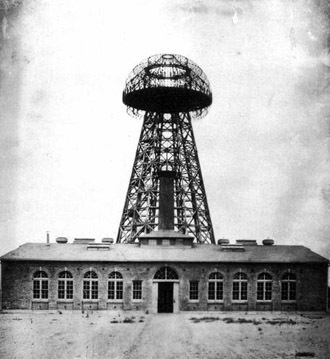
Tesla Tower (Photo from Wikipedia.org)
Leonid and Sergey Plekhanov believe the construction of their “Planetary Energy Transmitter” would be much lighter than that of Tesla’s, decreased from over 60 to mere 2 tons – all because of the modern materials used for the framework and up-to-date conducting materials. Naturally, the installation would be equipped with advanced electronics.

“We’ve conducted the fundamental research studies, implemented the computational models and designed all the parts of the experiment. We will be able to perform energy transmission and measure the results. Will it be ‘global’ as Tesla suggested? Based on the research that we've already done – we believe it will be, and we going to prove it experimentally,” the scientists wrote.

The scientists are going to repeat Tesla’s experiment in the fall of 2014.

And if the experiment works, the scientists say that a free energy world with limitless global energy transmission is possible.

Still, there are a number of considerations regarding the huge solar panel installation proposed by the Plekhanovs. Besides the fact that the very production of solar panels, at least on the modern level of technology, is really damaging for the environment, the efficiency of such power generation is still very low.

Besides that, such production is very expensive. A square meter of solar panel costs approximately $200. A simple multiplication of the sum by the proposed 100,000 square kilometers give us a stunning sum of $20 trillion, more than the gross GDP of either the US or EU. That’s without infrastructure. And even if the cost of production falls by several times, it would still be unspeakably expensive, experts say.


http://rt.com/news/170468-tesla-tower-rebuild-project/

Wednesday, May 8, 2013

Nikola Tesla: Unlimited free energy forever – THEY dont want you to know


Uploaded on Jan 22, 2011

Nikola Tesla unlimited free energy forever

From Google Videos.

Lightworks Video&Audio

Hosted by Bill Jenkins, formerly of ABC Radio, this comprehensive documentary features physicists and inventors who are challenging orthodox science to bring this non-polluting technology forward despite ridicule and suppression. See actual working prototypes that defy classical physics including phenomenal experiments in anti-gravity and the transmutation of metals.

http://www.lightworksav.com/

Thursday, December 6, 2012

University Uses Tesla Technology to Wirelessly Charge Bus

Utah State University presented a first-of-its-kind electric bus that is charged through wireless charging technology in a demonstration Nov. 15.


The Aggie Bus rolled onto the streets carrying passengers today; just 16 months after USU demonstrated the first high-power, high-efficiency wireless power transfer system capable of transferring enough energy to quickly charge an electric vehicle. In July 2011, the USU Research Foundation demonstrated 90 percent electrical transfer efficiency of five kilowatts over an air gap of 10 inches. The demonstration validated that electric vehicles can efficiently be charged with wireless technology.

USU’s Wireless Power Transfer team, in cooperation with the Utah Science Technology and Research initiative’s Advanced Transportation Institute at USU, has designed a more efficient way to meet the nation’s transportation needs. By carefully applying a mix of modern advances in engineering and Nikola Tesla’s principles of induction, USU engineer Hunter Wu and his team have solved one of today’s vexing problems in WPT.

Their research has led to the development of a robust prototype, which has been fitted to the Aggie Bus. The prototype transfers power over an air gap where no physical contact is required. Wireless power transfer technology delivers a multitude of benefits to consumers that include greater reliability due to no moving parts or cords, added convenience through the elimination of plug-in charging, the assurance of safety by removing the risk of electrocution and aesthetically pleasing devices as a result of no visible wiring.


USU’s Aggie Bus has achieved several significant milestones. It is the first bus developed and designed by a North American organization that is charged with wireless power transfer technology and is the world’s first electric bus with WPT technology combining the three following performance metrics: A power level up to 25 kilowatts, greater than 90 percent efficiency from the power grid to the battery and a maximum misalignment of up to six inches.

“The unveiling of the Aggie Bus today is a historic achievement and a great leap forward in the science and engineering related to electric vehicles,” said Robert T. Behunin, Ph.D., USU vice president of commercialization and regional development. “As a result of the work done by Utah State engineers, scientists and partners, EV owners and operators will now be able to simply drive over a pad in the ground to recharge their batteries, the benefits of which reach far beyond convenience.”

WAVE Inc., a Utah State University spin-out company, worked in cooperation with the USTAR Advanced Transportation Institute to develop the Aggie Bus. WAVE tackles the problem of heavy and expensive electric vehicle batteries through wireless power that transfers electricity between vehicles and the roadway. The Aggie Bus represents a market-ready product that will be used to retire significant technical risk as WAVE moves onto full-scale projects next year.

WAVE, in partnership with the Utah Transit Authority, will launch its first commercial demonstration in mid-2013 on the University of Utah’s campus. It will feature a 40-foot transit bus on a public transit route and an increase in wireless power transfer charging from 25 kilowatts to 50 kilowatts.

The project has been funded by a $2.7 million TIGGER grant from the Federal Transit Administration and the University of Utah which purchased the bus. WAVE intends to deliver a commercially ready product that operates with the same reliability as current public transit bus options, including diesel and compressed natural gas buses.

How it works:
 

“Current battery limitations prevent an all-electric transit bus from operating all day from an overnight charge. WAVE solves that problem by charging the bus wirelessly during its daily operations when the bus stops to load and off-load passengers,” said Wesley Smith, CEO of WAVE. “This technology makes electric buses competitive with their diesel hybrid and CNG counterparts.”
Utah State University has refashioned the way in which it conducts its technology transfer operation.

The office of Commercial Enterprises, a division of Commercialization and Regional Development, provides a one-stop-shop for industry partnership and intellectual property development. The Utah Science Technology and Research initiative is an innovative and far-reaching initiative of the Utah legislature to bolster Utah’s high-tech economy by investing in university research programs and recruiting new, high caliber faculty. Utah State’s wireless power transfer team is a significant part of USU’s USTAR portfolio.

SOURCE: Utah State University and WAVE Inc